ServiceNow AI Workflows Enter Production
ServiceNow launched AI tools to scale enterprise automation. Here is how to make these systems work in production.
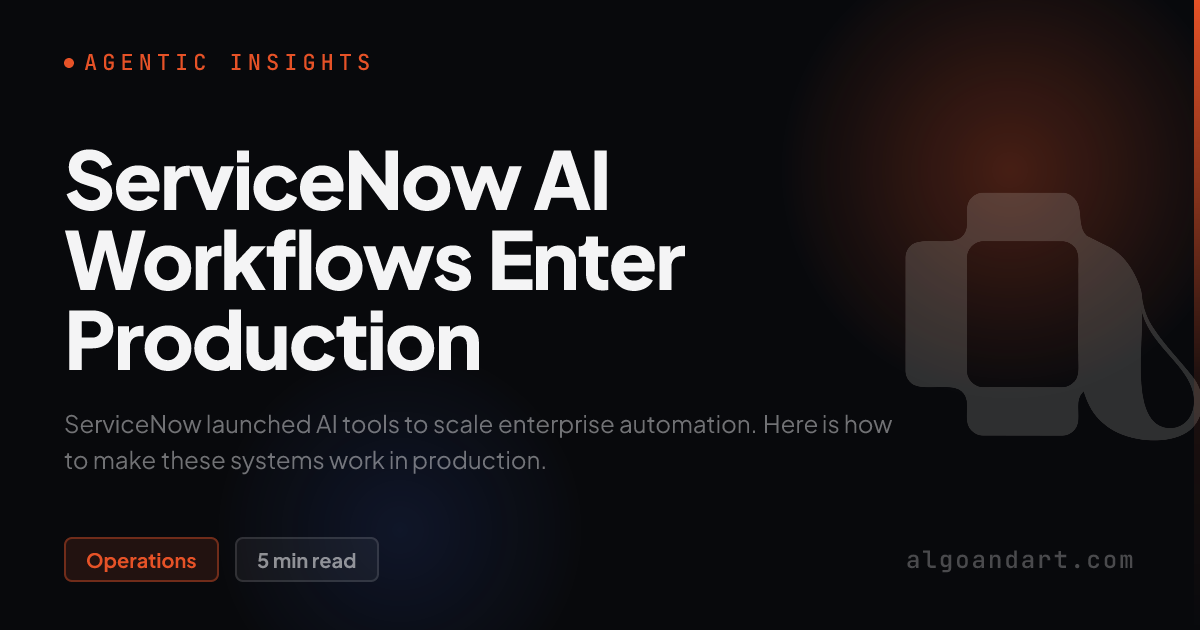
On October 6, 2026, ServiceNow announced its AI Workflow Factory and Autonomous Engineer solutions at the World Forum Mumbai to help companies automate their operations. These new tools aim to solve a major headache for enterprise technology leaders. Many companies have spent the last few years building AI models, but they struggle to connect them to daily operations.
ServiceNow targets legacy gaps with new AI tools
By helping enterprises build, run, and extend workflows, these new tools make it easier to scale business operations in days rather than months. This is particularly important for companies stuck with fragmented legacy systems that do not talk to each other. Instead of waiting for a complete system overhaul, organizations can use these tools to connect their existing applications.
The initial adoption of these developer capabilities is already happening. ServiceNow's partner network in India is integrating these tools to speed up client projects. This shows a clear demand for automated systems that can handle complex work without needing constant human oversight.
The reality of autonomous engineering in the enterprise
Autonomous engineering represents a major shift in how companies write software. The Autonomous Engineer tool focuses on unattended coding, planning, and testing. Instead of a human developer writing every line of code, the system handles the heavy lifting.
But running unattended code in a live business environment comes with real risks. If an autonomous agent misinterprets a requirement, it could deploy broken code directly to your network. That is why companies cannot simply turn these tools on and hope for the best.
To use autonomous engineering safely, you need to build a system of checks and balances. We design testing pipelines that act as a safety net. Every piece of code generated by an AI must pass through multiple automated tests before it is deployed.
We also focus on creating clear feedback loops. When the system identifies an error during testing, it feeds that information back to the generator so it can correct its own mistake. This continuous cycle of generation and verification is what makes autonomous engineering practical for large businesses.
Why governance is the real bottleneck for agentic systems
The conversation around AI often focuses on speed, but governance is what actually determines whether a project succeeds. ServiceNow emphasized governed, enterprise-wide AI transformation during its announcement. This is a vital point that many early adopters miss.
When an AI system makes decisions on its own, determining responsibility becomes a major challenge. This is why ServiceNow focused on governed, enterprise-wide AI. If your security and compliance teams do not trust your AI systems, those systems will never leave the testing environment.
At Algo & Art, we help companies build these security guardrails from day one. We set up strict access controls that limit what an agent can do. For example, an agent might be allowed to read a database but blocked from making changes without human approval.
And we make sure those rules are baked into the system. Every action taken by an autonomous agent is recorded in a way that cannot be altered. If a regulator asks why a specific decision was made, you can show them the exact path the agent took. This level of transparency is non-negotiable for companies in finance, healthcare, and other regulated sectors.
How we build the operational plumbing for enterprise AI
While platforms like ServiceNow provide a strong foundation, they are not a complete solution on their own. Every enterprise has a unique mix of custom software, private databases, and specific business rules. Connecting a general tool to this specific environment requires careful planning and engineering.
This is where Algo & Art helps. While some teams stop at building simple AI demos, we focus on the operational plumbing that keeps these systems reliable at scale. This includes agent orchestration alongside custom data pipelines. We also build continuous evaluation frameworks.
These evaluation systems constantly monitor your agents to ensure they are still meeting your standards. AI models can drift over time, and their performance can degrade. If performance drops, the system alerts your team so you can make adjustments before it affects your customers.
We also help companies bridge the gap between platforms like ServiceNow and their custom internal tools. By building clean integrations, we ensure your AI workflows can access the data they need without creating security risks. This is how you turn a promising technology into a reliable business asset.
Frequently asked questions
What is the ServiceNow AI Workflow Factory?
It is a new solution launched on October 6, 2026, designed to help companies build, run, and extend AI workflows across their business. It helps bridge execution gaps caused by old, fragmented infrastructure so companies can scale operations quickly.
How does the ServiceNow Autonomous Engineer work?
It is a tool that provides capabilities for unattended coding, planning, building, and testing of implementation work. It allows companies to automate development tasks with minimal human intervention.
How does Algo & Art help companies implement these tools?
We build the underlying orchestration, pipelines, and guardrails required to run these autonomous systems safely in production. We help connect enterprise platforms to your custom infrastructure while maintaining strict governance.